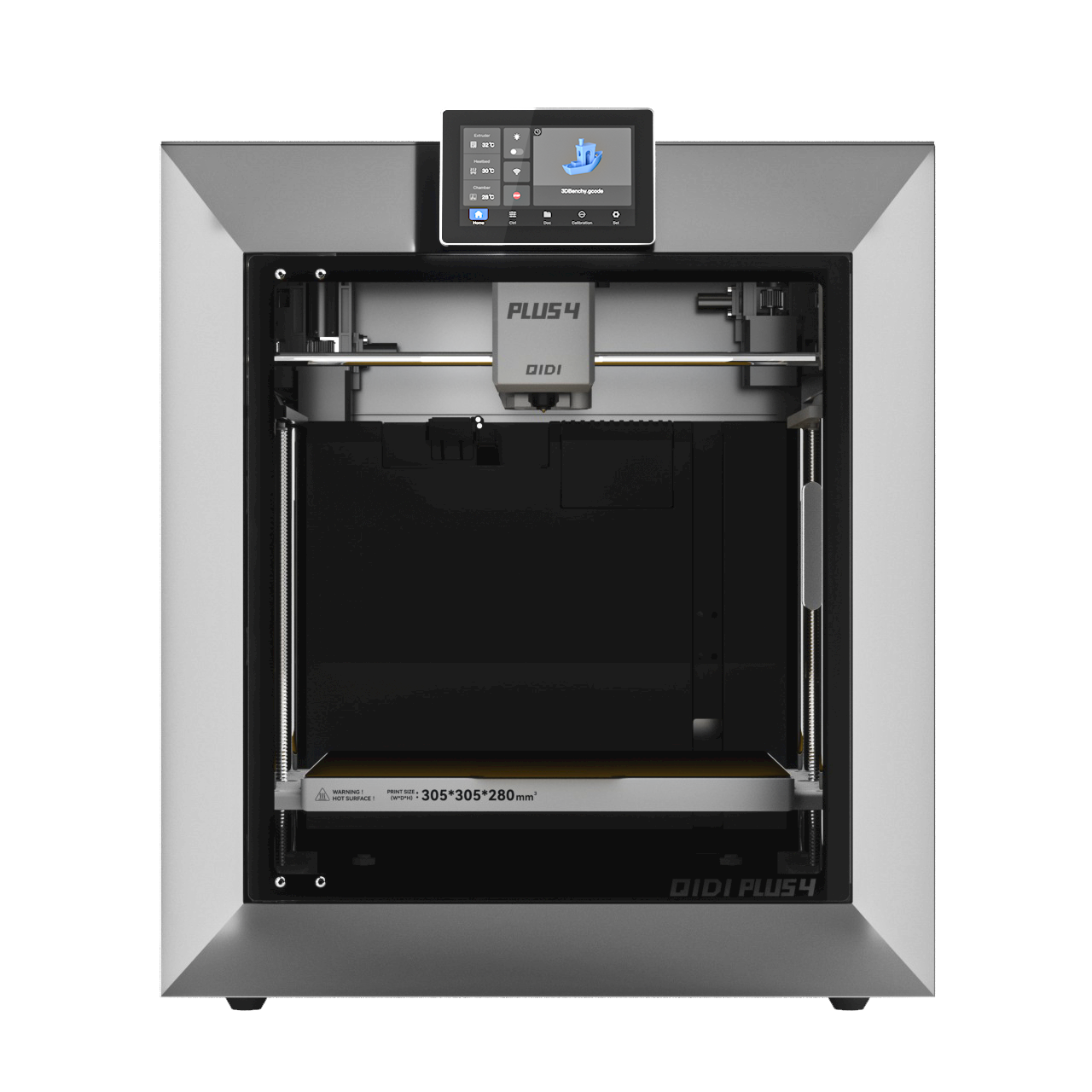
Our verdict: ABS, ASA and nylon parts that warp elsewhere
QIDI Plus4
Enclosed CoreXY with heated chamber · QIDI
A 305 mm enclosed CoreXY with an actively heated chamber and a 370 °C hotend.
Best forABS, ASA and nylon parts that warp elsewhere
Key specs Manufacturer data
- Technology
- FDM, CoreXY, enclosed
- Build volume
- 305 × 305 × 280 mm
- Max nozzle temp
- 370 °C
- Extruder
- Direct drive, dual-metal high-flow nozzle
- Bed leveling
- Automatic
- Enclosure
- Enclosed, actively heated chamber
- Screen
- 5"
- Connectivity
- LAN, Wi-Fi, USB
- Machine size
- 505 × 487 × 550 mm
- Weight
- 27 kg
Why it stands out
- Actively heated chamber
- 370 °C hotend for engineering filaments
- Klipper with Fluidd interface
Trade-offs
- 27 kg and a large footprint
- Tom's Hardware found it difficult to load
Spec sources: qidi3d.com, tomshardware.com
The headline specs
- Technology: FDM, CoreXY, enclosed
- Build volume: 305 × 305 × 280 mm
- Max nozzle temp: 370 °C
- Extruder: Direct drive, dual-metal high-flow nozzle
- Bed leveling: Automatic
- Enclosure: Enclosed, actively heated chamber
- Screen: 5"
- Connectivity: LAN, Wi-Fi, USB
Spec sources: qidi3d.com, tomshardware.com. Specs checked .
What stands out
Tom's Hardware praised the Plus4's print quality, heated chamber and build quality, and its Klipper firmware with the Fluidd web interface. QIDI's store highlights auto calibration; it uses a 5-inch HD touch screen (800 × 480).
Who it suits, who should skip it
- Best for: ABS, ASA and nylon parts that warp elsewhere.
- Skip it if you print mostly PLA or have no room for a 27 kg machine.
Recommended settings and materials
The Plus4 is the machine in this list built for engineering materials, so set it up for them. The actively heated chamber is what keeps large ABS, ASA, nylon and polycarbonate parts from warping and splitting between layers: let it reach temperature before starting, and keep the door closed throughout. The 370 °C hotend covers high-temperature filaments; abrasive carbon or glass-filled blends need a hardened or bimetal nozzle and a dried spool, and nylon should go from the dryer straight to the printer. For PLA, open the door and lid and turn chamber heating off, or the filament can soften before it reaches the nozzle.
Temperature ranges are common starting points from filament and resin makers: always follow the label of the spool or bottle you use.
Living with it: upkeep and running costs
At 27 kg and 505 × 487 × 550 mm, the Plus4 needs a solid bench and two people to move. The heated chamber adds power draw during long engineering prints, so check your circuit if it shares a socket with other heaters. Keep spare nozzles, PEI plates and the carbon filter in stock; Qidi sells most parts directly. Tom's Hardware found filament loading awkward, so take a few minutes with the manual before the first print. The Klipper firmware with the Fluidd interface gives advanced users full control over the machine from a browser.
Before you buy: checklist
- Plan a bench that can take 27 kg and a 505 × 487 mm footprint, with room to open the door.
- List the materials you will print: the heated chamber only pays off with engineering filaments.
- Budget for a filament dryer: nylon and PC are unprintable when wet.
- Multicolor needs Qidi's separate QIDI Box, sold as an add-on.
Where to buy
| Merchant | Type | Link |
|---|---|---|
| QIDI store (EU) | affiliate link | QIDI store (EU) |
| QIDI | no commission | Official store |
Other options
The Plus4's actively heated chamber is what separates it from the rest of this group. The Creality K1 Max offers a similar 300 mm cube and 18 kg instead of 27 kg, but its 300 °C nozzle and unheated chamber limit it to less demanding materials. The Anycubic Kobra S1 Combo and Elegoo Centauri Carbon 2 Combo are smaller (250 and 256 mm), cheaper to run in multicolor and reach 320 °C and 350 °C respectively, but neither heats its chamber. If you print nylon, polycarbonate or large ABS parts for functional use, the Plus4 is the safer bet; for multicolor PLA and PETG, the others make more sense.
 Read the reviewCreality K1 MaxA 300 mm cube with LiDAR first-layer checks.
 Read the reviewAnycubic Kobra S1 ComboAnycubic's enclosed CoreXY with a 120 °C bed and ACE multicolor.
 Read the reviewElegoo Centauri Carbon 2 ComboElegoo's second-generation enclosed CoreXY, sold with 4-color CANVAS.
How it compares
Swipe sideways to compare all 4
| Spec | QIDI Plus4 | Creality K1 Max | Anycubic Kobra S1 Combo | Elegoo Centauri Carbon 2 Combo |
|---|---|---|---|---|
| Technology | FDM, CoreXY, enclosed | FDM, CoreXY, enclosed | FDM, CoreXY, enclosed | FDM, CoreXY, enclosed |
| Build volume | 305 × 305 × 280 mm | 300 × 300 × 300 mm | 250 × 250 × 250 mm | 256 × 256 × 256 mm |
| Max nozzle temp | 370 °C | 300 °C, hardened steel nozzle | 320 °C | 350 °C, hardened steel |
| Extruder | Direct drive, dual-metal high-flow nozzle | Dual-gear direct drive, 32 mm³/s max flow | Dual-gear direct drive | — |
| Bed leveling | Automatic | Automatic + AI LiDAR first-layer scan | — | — |
| Enclosure | Enclosed, actively heated chamber | — | — | Enclosed chamber with smart grille |
| Screen | 5" | 4.3" | 4.3" | — |
| Connectivity | LAN, Wi-Fi, USB | LAN, Creality Cloud, USB | — | ELEGOO app, USB drive |
| Machine size | 505 × 487 × 550 mm | 435 × 462 × 526 mm | 400 × 410 × 490 mm | — |
| Weight | 27 kg | 18 kg | 18 kg (ACE Pro 4.6 kg) | — |
| Max speed | — | 600 mm/s (300 mm/s typical) | 600 mm/s (300 mm/s recommended) | 500 mm/s |
| Max acceleration | — | 20,000 mm/s² | 20,000 mm/s² | 20,000 mm/s² |
| Camera | — | AI camera | 480p | — |
| Max bed temp | — | — | 120 °C | 110 °C |
| Multicolor | — | — | ACE Pro: 4 or 8 colors | CANVAS, 4 colors |
| Where to buy |
Frequently asked questions
Is the QIDI Plus4 enclosed?
Enclosed, actively heated chamber.
What is the QIDI Plus4 build volume?
305 × 305 × 280 mm, according to QIDI.
Why does a heated chamber matter?
Large parts in ABS, ASA, nylon or polycarbonate cool unevenly in open air, which causes warping and cracks between layers. A heated chamber keeps the whole part warm while it prints.
Can the Qidi Plus4 print in several colors?
Not on its own. Qidi sells the QIDI Box as a separate multicolor add-on for the Plus4.
Is the Qidi Plus4 good for PLA?
It prints PLA well with the door and lid open and chamber heating off, but you would be paying for engineering features you do not use.
Did you test the QIDI Plus4 yourselves?
No. This page is based on the manufacturer's published specifications and on public reviews, which we cite and date. If a brand lends us a unit, the page will say "Tested by the team".